Figuring the apocalypse: jessie beier’s Pedagogy at the end of the world

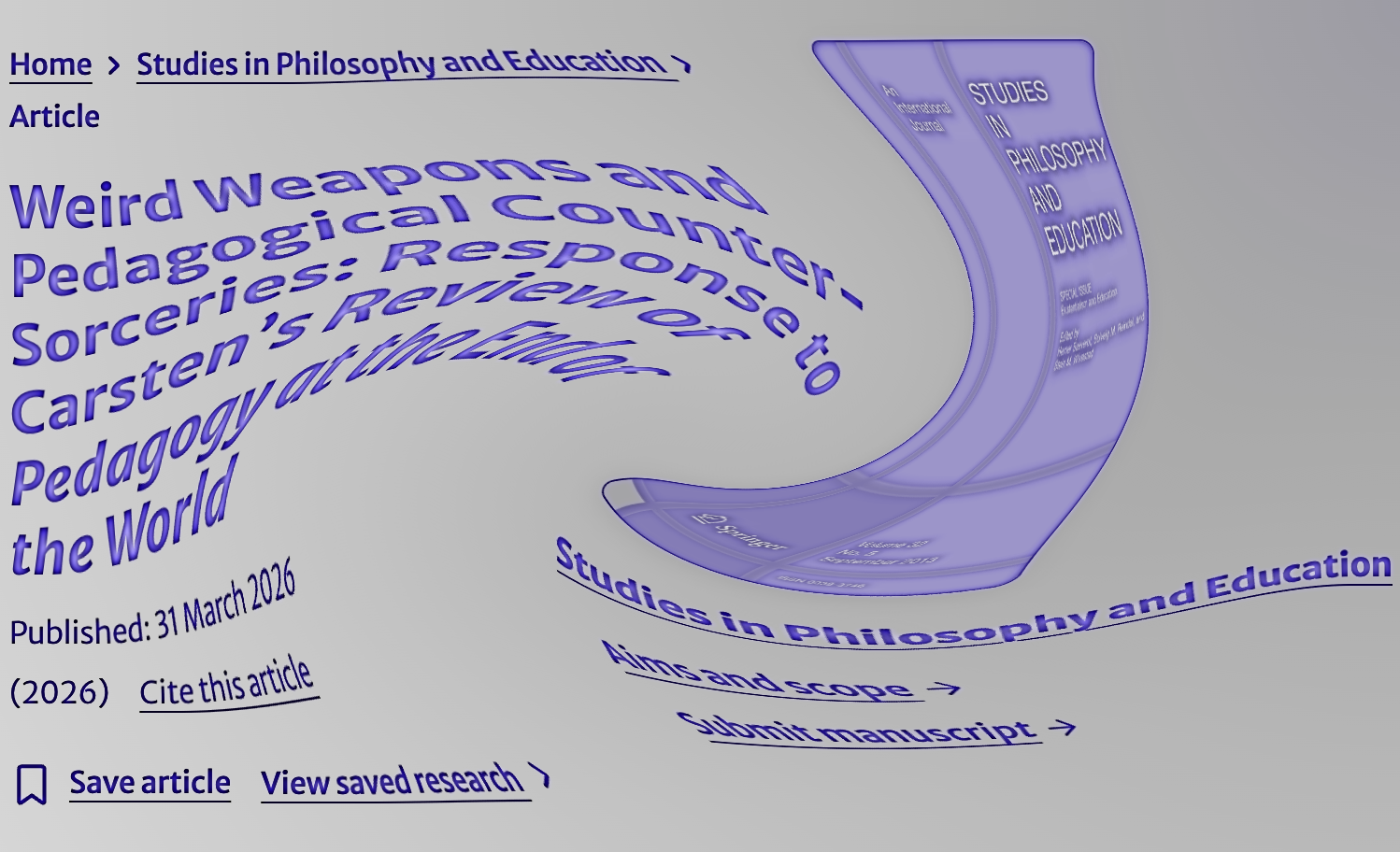
A new review of Pedagogy at the End of the World is out in the world in Studies in Philosophy and Education! In “Figuring the apocalypse,” Delphi Carstens tracks the book’s weird wagers, offering a super thoughtful, generous, and critical take on the work.

Here’s a taste…

“Beier’s Pedagogy at the end of the world: weird pedagogies for unthought educational futures (2023) provides us with rich source material from which to launch a counter-sorcery of pedagogical negation. Her book arrives at a crucial moment when, with wars on four continents, multiple planetary boundaries exceeded, and neo-fascist revanches on the rise, obsolete humanist logics remain firmly sedimented at every level of social reproduction (including education). Identifying, connecting and binding the holes and gaps that the rapidly advancing ‘end of the world’ event have created in education’s stilted vision of a world-for-us, Beier shows how a non-normative weird pedagogy, appropriate to our situation of escalating permacrisis, might go about mobilising techno-scientific aporias, uncanny socio-economic situations and more-than-human contact zones from which educational futures can and must emerge. The lingering spectre of the terror of history raises discomforting questions about education’s relation to being and non-being, life and death, finitude and extinguishment. This spectre demands from education a justice to come for a people to come; it requires pedagogues to converse with its uncanny presence by casting lines to the absolute outside of human giveness.”

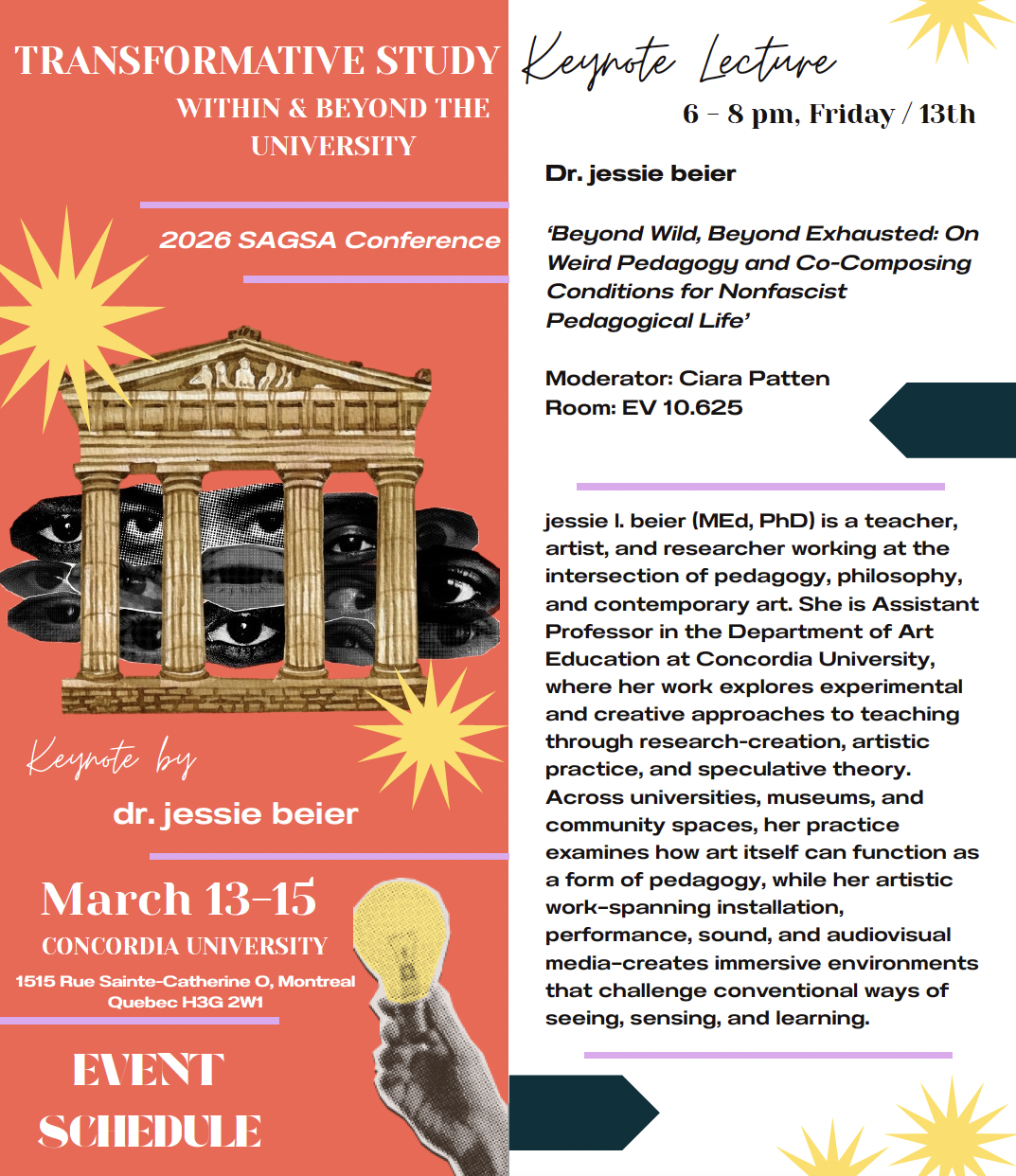
SAGSA Keynote: Beyond Wild, Beyond Exhausted: On Weird Pedagogy and Co-Composing Conditions for Nonfascist Pedagogical Life

I was honoured to be invited as the keynote speaker for the Sociology and Anthropology Graduate Student Association (SAGSA) conference, Transformative Study: Within and Beyond the University, held at Concordia University in Montreal from March 13–15, 2026. The gathering brought together graduate students, researchers, and artists to collectively think through what it means to study in a moment where the boundaries of the university—its spaces, practices, and purposes—are increasingly disturbed and disturbing.

ABSTRACT

In the introduction to The Undercommons, Jack Halberstam draws out Fred Moten and Stefano Harney’s gesture toward the wild beyond—what they call “beyond the beyond”—a space of study that is not outside the university, not an after or an elsewhere, but something that is always already here. The path to this wild beyond—“the common beyond and beneath”—is, Halberstam writes, paved with refusal. Reform will just not do. Nor will critique at/as distance, especially where “the critical academic has become the professional par excellence,” where critique circulates as credential, as job description, and even dissent becomes a form of professional credit. No, the subversive intellectual, Moten and Harney tell us, does not want to fix the university through better critique or smarter reform. She does not want to redeem it. She does not want to save it. She wants to believe, to believe in the world, and in another world in the world, to stay a believer (like Curtis Mayfield, like Deleuze) all the way to the end of it.

Written over a decade ago, these fugitive propositions return today under conditions that feel beyond wild. It’s wild out there, we say, shaking our heads, as equity infrastructures are hollowed out and environmental protections are rolled back; as arts and humanities programs quietly disappear alongside entire futures once imagined for something called “public” education; as universities increasingly resemble border regimes, audit machines, and austerity engines rather than sites of study; as algorithmic spectacle collapses governance, culture, and violence into a single predictive feed that sorts and optimizes, administers and smooths, exhausting attention, time, and planetary resources along the way. This non-exhaustive list is itself exhausting, but it only skims the surface of a deeper exhaustion—of bodies but also possibility—one produced by the relentless capture of study by debt, of learning by accreditation, and by the punitive demand to remain legible, compliant, and “realistic” even as the world grows more incoherent, more volatile, more brutal by the day. Worn down and weary, collective capacities for study are stretched and strained: desire contracts into individualized survival logics; energy dissipates into thin air; and organizing feels harder to imagine, harder to sustain, harder to hold together.

Drawing on ongoing experiments in what I call weird pedagogy, this talk wants to think with the wild beyond (and with what now feels beyond wild) to ask what pedagogy might still do under such exhausting and exhausted conditions. Here, pedagogy becomes a site of struggle. As Moten and Harney ask, “what would it mean if teaching—or rather what we might call the beyond of teaching—were precisely what one is asked to get beyond?” In this question, the beyond of teaching names not a refusal of pedagogy, but a refusal of indebted educational forms where teaching metabolizes tiredness, siphons off desire, and insists that we call what is left “just the way things are.” Attuned to this threshold, this beyond the beyond, this talk asks how weird pedagogy might create experimental conditions for co-composing nonfascist pedagogical life, and thus fragile but necessary potentials for belief in study in beyond wild times.

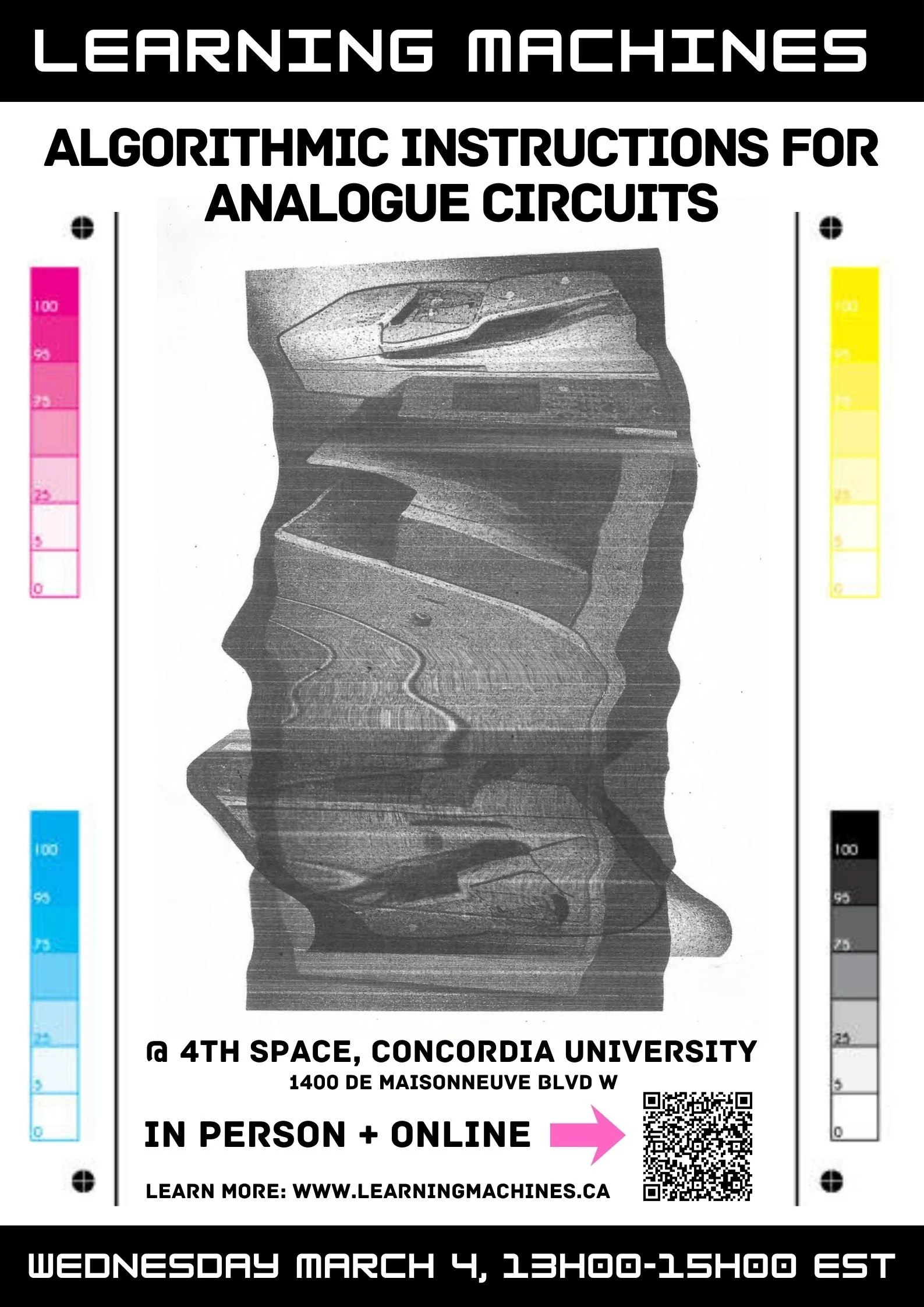
Learning Machines: Algorithmic Instructions for Analogue Circuits

Wednesday, March 4th, 13h00-15h00 EST @ 4th Space - Concordia University

Learning Machines: Algorithmic Instructions for Analogue Circuits is a live, public experiment in machinic pedagogies, where transparency shifts from promises of clarity and control toward a limit point where instruction breaks down and learning amps up! 

Tender Circuits: Scores for Artificial Intimacies - Workshop @ Karlsruhe University

This one-day workshop engages participants in prototyping alternative pedagogies that critically and creatively explore the entanglements of computation, care, and contemporary art education. Drawing from conceptual art strategies such as scores, prompts, and performative instructions, participants will collaboratively create and enact a series of lo-fi instructional artworks that foreground aesthetic, political, and material questions about teaching and learning in an age of artificial intimacies.

Read more >>>

Artificial Intimacies: Figuring Care in the Age of AI (Talk)

On October 21, I joined the Care Research Lab (University of Cologne / University of Education Karlsruhe) to give an online lecture titled Artificial Intimacies: Figuring Care in the Age of AI..

Artificial Intimacies: Figuring Care in the Age of AI (Talk)

What happens when machines are trained to care? From wellness platforms that track mood and behaviour, to therapeutic chatbots, classroom emotion-recognition software, and the AI girlfriend/boyfriend experience, today’s algorithmic tools increasingly promise intimacy, attentiveness, and support—while simultaneously reorganizing perception, flattening sensation, and quietly hardwiring normative models of emotion, embodiment, and subjectivity. As these systems rush to patch the widening holes in precarious care infrastructures, they do so by running on hidden circuits of energy and data, tied to ever-intensifying regimes of planetary extraction and the spectre of human labour that props up so-called artificially intelligent systems. To figure care in the age of AI is thus to ask how today’s “feeling machines” sense and standardize intimacy, how affective labour is black-boxed into protocols of learning, and how work, energy, and desire are recoded to naturalize some forms of care as authentic, others as artificial. Drawing on recent research-creation projects, the talk weaves theoretical inquiry, artistic experimentation, and pedagogical reflection to investigate care as a site of tension and ambivalence—where intimacy meets infrastructure, tenderness becomes protocol, and collective resistance might be reworked with and beyond the machine.

WATCH THE ONLINE TALK HERE!


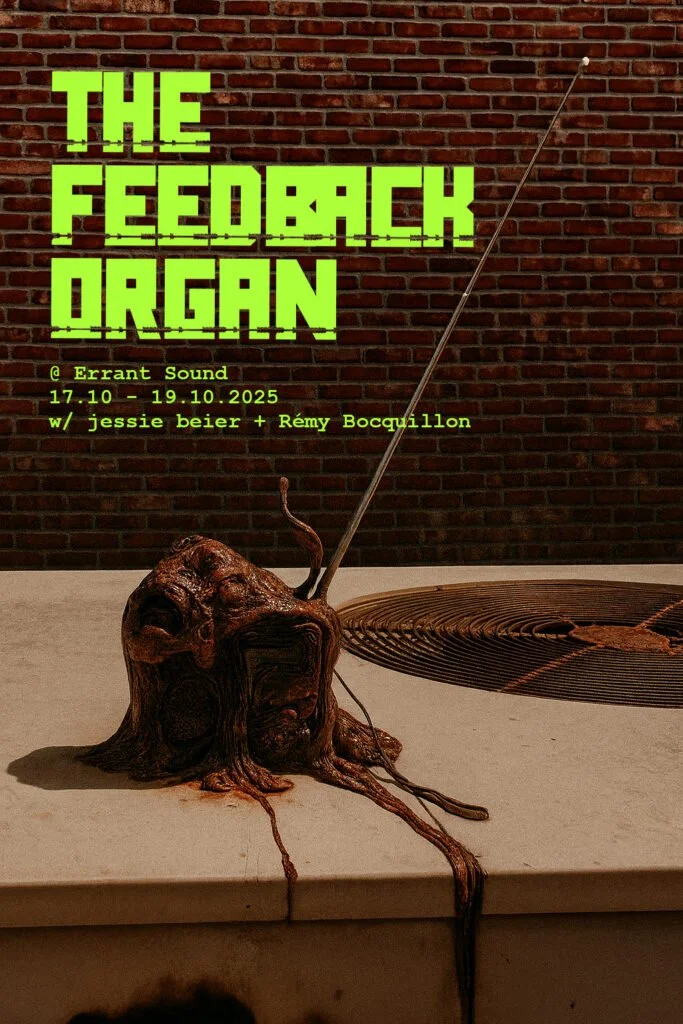
The Feedback Organ @ Errant Sound


Performance | Installation | Séance | Sonic Sabotage

Pocket Artist Residency @ Errant Sound (Berlin)
Sat 18th 5-7 pm: "happy hour" and informal Q&A with the artists
Sun 19th 6-9 pm: performative installation, ongoing

Errant Sound is excited to host jessie beier & rémy boquillon´s The Feedback Organ at the Gerichtstrasse 45 (Errant Sound@Miss Read). Join us for "happy hour" on Saturday from 5 to 7 pm to experience the project and chat with the artists in an informal atmosphere. You are also welcome to drop by on Sunday between 6 and 9 pm, to listen to The Feedback Organ in interaction with the artists.

A machine that plays a score. A score that machines a play. A play that scores a machine.

The Feedback Organ is an experimental machine-in-the-making that vibrates across dead air and broken timelines. Equal parts performance, installation, séance, and sonic sabotage, this contraption conjures the long-lost ghosts of pirate frequencies and the unheard-of ghoulies of algorithmic noise. Through a tangled ecology of radios, samplers, tapes, delay loops, and live-coded scripts, this machinic organ—part nervous system, part scrapyard ritual—will pulse and twitch and crawl its way across analogue and digital surfaces, leaving feedback trails and sonic scars in its wake.

READ MORE >>>


Out Now: FluxKit for Energy Transition + Reflector Podcast

The FluxKit for Energy Transition, developed by the Speculative Energy Futures (SEF) team under the Just Powers project, is now available online—alongside Episode 7 of the Just Powers: Reflector podcast, which features several projects I contributed to with some dear collarborators, including Energy Emergency Repair Kit (E.E.R.K.), Paramancy, and Notes from the Energetic Quietus.

Listen to the Reflector Podcast episode here >>>
Learn more about the FluxKit for Energy Transition here >>>

Future Observatory Journal - Issue No2 More Than Human

Check it out! The second issue of issue no. 2 of the Future Observatory JournalMore than Human - is (a)live! Super thrilled to have been invited to contribute the the Worlding section, a forecast that gathers ideas, critiques, and scenarios on more-than-human futures. (Big thanks to Jennifer Cunningham for the invite and for all of her amazing work on the issue!) 

The FOJ is an interactive platform that blends research, writing, and design to reimagine how humans live among other species. Alongside Worlding, the Practice section features case studies from artists, designers, and collectives such as Studio Ossidiana, Duane & Raby, James Birdie, Justin McGuirk and Anna Tsing. 

Explore the full issue here: Future Observatory Journal

Canadian Art Teacher 20.2

Out now! The latest issue of Canadian Art Teacher / Enseigner les arts au Canada (TWENTY/VINGT 20, vol. 20.2) is now live. This special anniversary issue celebrates 20 years of publishing in the art education community with 20 reflective and creative contributions from artists, teachers, and scholars across Canada.

I contributed some thoughts on hope(lessness) to a new section, Art Educators’ Perspectives in Art Education, organized by guest editor Nancy Long and artist-teacher Cynthia van Frank.

You can read the full issue here: Canadian Art Teacher (and soon on Érudit).

Summer Reads Feature: Sound Research in Troubling Times

Our edited collection Sound Research in Troubling Times: Hope in Crisis (co-edited with Owen Chapman) was featured in Concordia’s Faculty of Fine Arts “Summer Reads” list. The piece highlights recent publications across design, dance, and sonic research, offering cross-disciplinary insight into creative practices in turbulent times. Grateful to be included alongside such inspiring work.

Check it out here >>>

Split Solstice Record Now Online

In honour of the summer solstice, Split Solstice—a collaborative sound project between Nik Forrest and Owen Chapman—is now available online. I created the artwork for this double lathe-cut record, which captures very low frequency (VLF) signals recorded simultaneously in Gaspé, Quebec, and Lofoten, Norway, on June 21, 2022. These natural and technological electromagnetic sounds were exchanged, composed, and pressed onto a two-record set: one side featuring audio compositions, the other a selection of raw VLF recordings.

Collective Musicking Toward Hope/less Horizons and Horizon/less Hopes - Workshop w/ Annabelle Brault @ 4th Space

Workshop at C-Change Conference 2025

I’m excited to co-facilitate a workshop with Annabelle Brault as part of this year’s C-Change Conference at Concordia University. C-Change 2025 runs from June 14–19 and includes events at Concordia’s 4th Space, Jesuit Hall at the Loyola Campus, a therapeutic farm in North Lancaster, and online via Zoom.

Our session, titled Collective Musicking Toward Hope/less Horizons and Horizon/less Hopes, will take place Monday, June 16, 2025, from 1–3 p.m. Drawing on sonic and visual excerpts from an August 2022 artist residency and performances with the collective Landscape of Hate, we will explore the theme of hope/less horizons and horizon/less hopes through collective sound-making exercises that invite sensing, listening, and imagining otherwise, together.

Find out more about the Workshop here >>>

Find out more about the C-Change Conference here >>>

Rocket Science Room: General Audience Talk

On May 28, 2025, I will join with others at the Rocket Science Room for General Audience #17: ANTIFASCISM for a public conversation on daily practices of anti-fascism — planning to share some thoughts on speculative experiments in pedagogy, desire, and collective care as part of a broader inquiry into what it means to co-compose conditions for nonfascist life today.

More info >>>

General Audience #17: HOW BAD IS IT? 

General Audience is back at Rocket Science Room! 

General Audience is a community-based, informal lecture series, which provides an opportunity for people to share experience, knowledge, research, creative projects, information, or ideas with each other in a comfortable and friendly environment. Past themes for talks have included: PLAY, SOUND, DATING, GARBAGE, OUTER SPACE, PORNOGRAPHY, FEAR, PRISONS, MAGIC and TASTE.

After a long hiatus due to COVID (and Jessie’s move across the country to B.C.), General Audience Montreal is finally resuming with its 17th event: HOW BAD IS IT? With presentations (in English) from local anti-fascist organizers and thinkers exploring the rise of far-right movements in Quebec and beyond, emphasizing the urgency of resistance. Presentations will highlight both the broader political landscape and the power of everyday anti-fascist practices—through art, community, and conversation—while inviting open discussion in English and French. We hope to see you there!

Learning Machines: Live from the Black Box!

On Saturday, February 8, 2024, from 1–2 PM EST, the learning machines presented a one-hour live-streamed performance that dove headfirst into the enigmatic world of AI, algorithms, and computational tools.

During a week-long research-creation residency at Concordia University’s Black Box, we experimented with the unseen mechanisms that shape today’s learning machines—systems that simultaneously reveal and conceal how knowledge is made and how we, as subjects, are formed.

The performance featured a dynamic mix of energetic demands, virtual manifestations, recursive loops, glitched imaginations, machinic dreams, and warped memories as we explored what it means to learn, think, and create alongside today’s algorithmic learning machines.

Watch the DIY, livestreamed performance here! >>>

Out Now! Sound Research for Troubling Times: Hope In Crisis

Very excited to share this project that I made with my dear pal Owen Chapman and many of the folks I had the pleasure of making and thinking with during my postdoc at Concordia University. Check it out here!

/////

This edited collection takes the prompt “hope in crisis” as a starting point for investigating sound research as it is situated in these troubling times. The book brings together thinkers from numerous scholarly domains (i.e. communication studies, art education, creative art therapy, psychology and philosophy) to explore the question of hope as it relates to sonic research-creation practices in/and times of crisis. Importantly, while sound research is explored in this book in relation to hope, it is not offered up as a better way forward, nor is it presented as a solution. Sound research is instead posed as a question, with each author responding in their own way through experiments with the potentials, but also limits, of and for sonic practices. Central to the project, then, is the question of how to collectively and creatively respond to the increasingly difficult— even untenable—circumstances that have come to limit future possibilities, both within fields of research but also beyond, without falling back on the unquestioned assumption that hope alone will actualize a desired otherworld. The sound research gathered here experiments with such possibilities in order to grapple with how present conditions, including conditions for research, are always contingent—always already in trouble—and thus also subject to change both conceptually and materially.

Performance-Lecture w/ Rémy Boquillon @ Tangentiality: Passing Relations in the Arts, Literature, Music, and Performan

Tangentiality: Passing Relations in the Arts, Literature, Music, and Performance

University of Copenhagen, 15 Oct. - 17 Oct. 2024. Organizers: Department of Art and Cultural Studies / Stefanie Heine and Holger Schulze. READ MORE >>>

////

Cursory Touches: Algorithmic Mediation as Tangential Conjuring

jessie beier & Rémy Bocquillon (Assistant Professor, Concordia University Montréal, Art Education & Lecturer, Catholic University of Eichstätt-Ingoldstadt, Sociology)

The tangent – as line, as surface, as volume – is only actualized through encounter. This touching relation is always flee(t)ing, it is one of brief attention, an encounter en passant: the slight touching of shoulders on a crowded street, the longing brush of a hand along a dusty shelf, the skimming over of theories in an academic paper. A digressive departure? Or is it a distracted avoidance? Despite this “mere touching,” imprints, however slight, are left behind; traces are drawn, flows are redirected, desires remachined. The point of contact becomes a point of impact, a singular event wherein differential forces intersect in ways that we can’t see coming, only leaving. Such events carry no specific outcomes or utility, but they can nevertheless make their mark. The tangential relation, as cursory and punctual as it might be, is not indifferent, but emerges in difference. It is an encounter en passant that refuses to merely pass by.

Taking off from this tangential thinking, this collaborative performance-lecture experiments with passing relations as they might emerge, in unforeseen and non-linear ways, through aesthetic practices (where aesthetics refers to sensorial conditioning and perceptual distributions, aesthetics as aisthesis). In this particular occurrence, the invocation of tarot reading as an algorithmic medium turned occulted composition device will be combined with philosophical riffing and sonic computational techniques (such as live coding) in order to experiment with how seemingly codified and codifiable moments of interaction emerge not as causally-entangled relation but instead as “dark precursors” (Deleuze, 1994). Here, we understand the tangential relation as just one form of “aberrant nuptial” (Deleuze, 1994), as just one instance of the subtractive encounters that are enabled between the momentary touching of systems characterized by fundamental difference. It is through this touch that we hope to invoke, or better, conjure, unthought modes of collectivity where the “collective” refers to a sense of anorganic and inhuman multiplicity that deploys itself beyond individual entanglements toward “the side of preverbal intensities, indicating a logic of affects rather than a logic of delimited sets” (Guattari, 1995, p. 9). Through this performance-lecture we want to consider, in witchy ways, how the tangential meeting of “heterogeneous systems of couplings and resonance” (Assis & Giudici, 2017, p. 9) might impact our own thinking, as artists, teachers and researchers of sociology and pedagogy, in yet unthought ways.