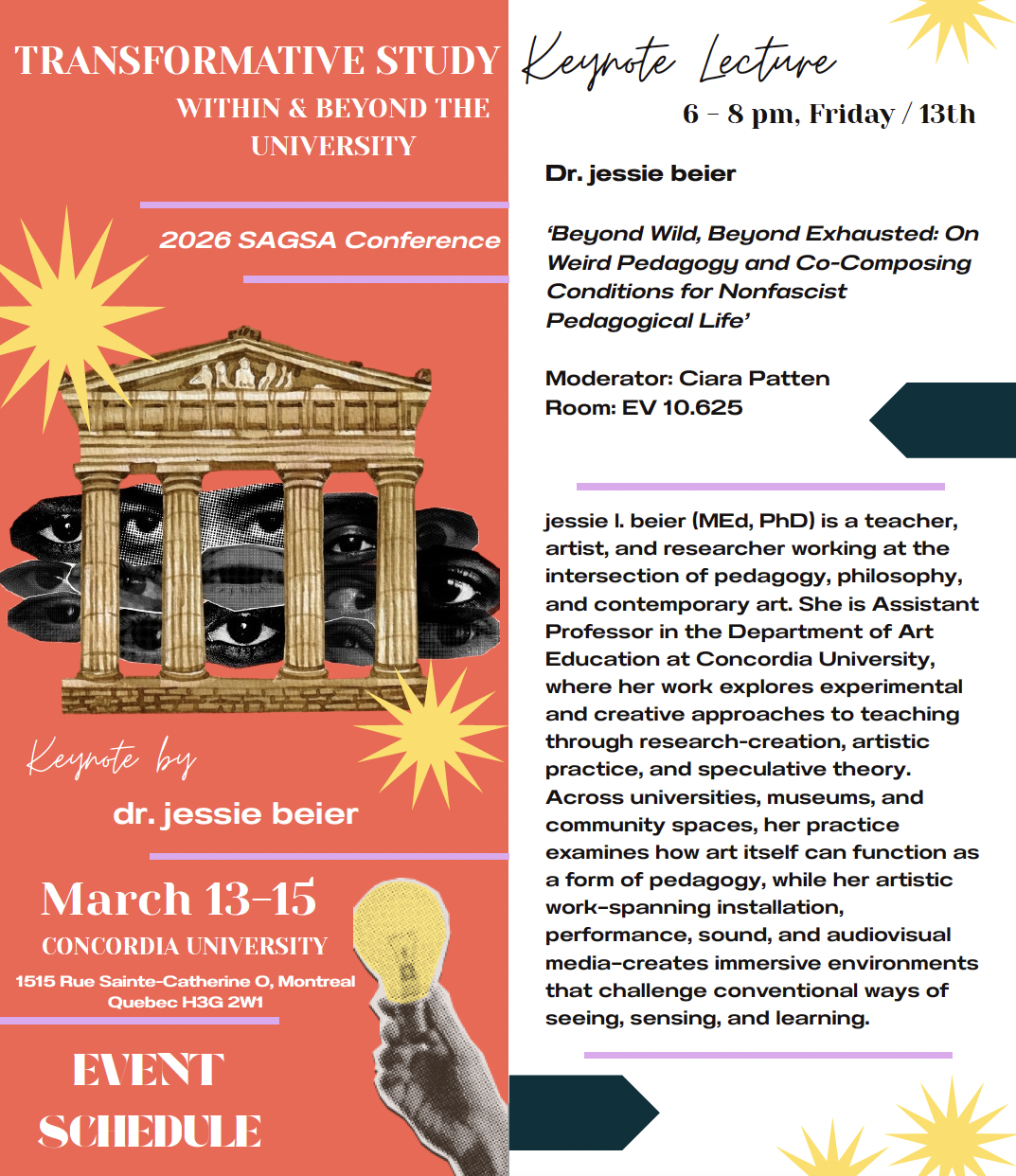
I was honoured to be invited as the keynote speaker for the Sociology and Anthropology Graduate Student Association (SAGSA) conference, Transformative Study: Within and Beyond the University, held at Concordia University in Montreal from March 13–15, 2026. The gathering brought together graduate students, researchers, and artists to collectively think through what it means to study in a moment where the boundaries of the university—its spaces, practices, and purposes—are increasingly disturbed and disturbing.
ABSTRACT
In the introduction to The Undercommons, Jack Halberstam draws out Fred Moten and Stefano Harney’s gesture toward the wild beyond—what they call “beyond the beyond”—a space of study that is not outside the university, not an after or an elsewhere, but something that is always already here. The path to this wild beyond—“the common beyond and beneath”—is, Halberstam writes, paved with refusal. Reform will just not do. Nor will critique at/as distance, especially where “the critical academic has become the professional par excellence,” where critique circulates as credential, as job description, and even dissent becomes a form of professional credit. No, the subversive intellectual, Moten and Harney tell us, does not want to fix the university through better critique or smarter reform. She does not want to redeem it. She does not want to save it. She wants to believe, to believe in the world, and in another world in the world, to stay a believer (like Curtis Mayfield, like Deleuze) all the way to the end of it.
Written over a decade ago, these fugitive propositions return today under conditions that feel beyond wild. It’s wild out there, we say, shaking our heads, as equity infrastructures are hollowed out and environmental protections are rolled back; as arts and humanities programs quietly disappear alongside entire futures once imagined for something called “public” education; as universities increasingly resemble border regimes, audit machines, and austerity engines rather than sites of study; as algorithmic spectacle collapses governance, culture, and violence into a single predictive feed that sorts and optimizes, administers and smooths, exhausting attention, time, and planetary resources along the way. This non-exhaustive list is itself exhausting, but it only skims the surface of a deeper exhaustion—of bodies but also possibility—one produced by the relentless capture of study by debt, of learning by accreditation, and by the punitive demand to remain legible, compliant, and “realistic” even as the world grows more incoherent, more volatile, more brutal by the day. Worn down and weary, collective capacities for study are stretched and strained: desire contracts into individualized survival logics; energy dissipates into thin air; and organizing feels harder to imagine, harder to sustain, harder to hold together.
Drawing on ongoing experiments in what I call weird pedagogy, this talk wants to think with the wild beyond (and with what now feels beyond wild) to ask what pedagogy might still do under such exhausting and exhausted conditions. Here, pedagogy becomes a site of struggle. As Moten and Harney ask, “what would it mean if teaching—or rather what we might call the beyond of teaching—were precisely what one is asked to get beyond?” In this question, the beyond of teaching names not a refusal of pedagogy, but a refusal of indebted educational forms where teaching metabolizes tiredness, siphons off desire, and insists that we call what is left “just the way things are.” Attuned to this threshold, this beyond the beyond, this talk asks how weird pedagogy might create experimental conditions for co-composing nonfascist pedagogical life, and thus fragile but necessary potentials for belief in study in beyond wild times.